Arduino as Isp Can Upload but Not With Programmer
Arduino as Internet service provider and Arduino Bootloaders
Arduino Internet access provider turns your Arduino into an in-circuit programmer to re-program AtMega chips.
What makes an Arduino what information technology is? Many things, but one of the most of import ones is the fashion every Arduino board is hands programmed with the Arduino Software (IDE). It is plenty to connect it to the calculator USB port and press the "Upload" icon to start a process that transfers your sketch into the Wink retention of the microcontroller.
The Bootloader
The behaviour described to a higher place happens thanks to a special piece of code that is executed at every reset of the microcontroller and that looks for a sketch to be uploaded from the series/USB port using a specific protocol and speed. If no connection is detected, the execution is passed to the lawmaking of your sketch.
This little (usually 512 bytes) piece of code is called the "Bootloader" and information technology is in an expanse of the memory of the microcontroller - at the end of the address space - that can't be reprogrammed every bit a regular sketch and had been designed for such purpose.
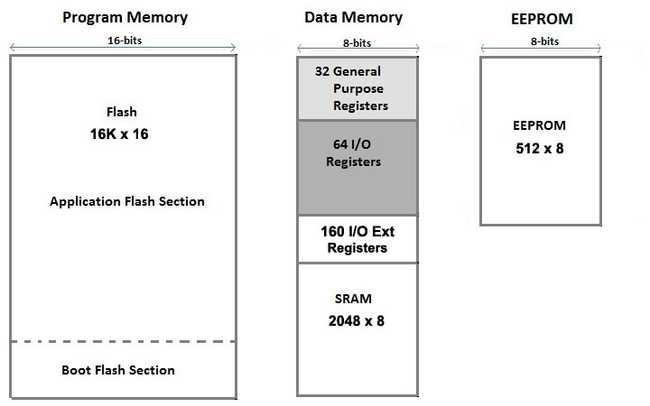
The Retentivity Map of an ATmega328P
To programme the bootloader and provide to the microcontroller the compatibility with the Arduino Software (IDE) y'all need to use an In-circuit Serial Programmer (ISP) that is the device that connects to a specific set of pins of the microcontroller to perform the programming of the whole flash memory of the microcontroller, bootloader included. The Isp programming procedure too includes the writing of fuses: a special set of bits that define how the microcontroller works under specific circumstances.
Employ Arduino as Internet service provider
The whole process of loading the bootloader lawmaking and burning properly the fuses to make an ATmega microcontroller an "Arduino" is managed by the Arduino Software (IDE): it provides a specific carte du jour detail and allows y'all to use a multifariousness of programming devices. Amidst the programmers, the "Arduino as ISP" is the cheapest and most practical solution to burn down a bootloader on some other Arduino lath with ATmega, 32U4 or ATtiny.
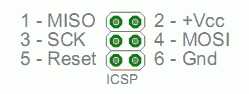
The programming process uses VCC, GND and four information pins. Three pins connect MISO, MOSI and SCK between the programming micro and the target micro, the fourth pin from the programming micro goes to the reset pin of the target.
How to wire your boards
The following table display on which pins the MOSI, MISO and SCK are cleaved out on the different Arduino boards:
| Arduino Board | MOSI | MISO | SCK | Level |
|---|---|---|---|---|
| UNO or Duemilanove | xi or ICSP-iv | 12 or ICSP-1 | xiii or ICSP-3 | 5V |
| Mega1280 or Mega2560 | 51 or ICSP-4 | l or ICSP-i | 52 or ICSP-three | 5V |
| Leonardo | ICSP-four | ICSP-1 | ICSP-3 | 5V |
| Due | ICSP-4 | ICSP-1 | ICSP-3 | 3.3V |
| Zero | ICSP-4 | ICSP-1 | ICSP-3 | 3.3V |
| 101 | 11 or ICSP-iv | 12 or ICSP-1 | thirteen or ICSP-3 | three.3V |
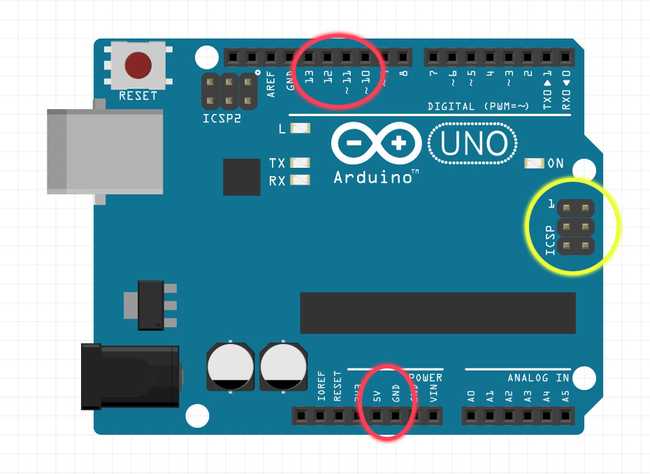
The SPI interface - and therefore these pins - is the interface used to program the AVR microcontrollers. Note that MISO, MOSI, and SCK are available in a consistent concrete location on the ICSP header; this connector is used also by shields that rely on the SPI interface allowing the blueprint of shields that work on every board.
On the Arduino UNO in the following prototype, we have highlighted in red the connections on the female strips; in xanthous the ICSP connector that connects to the ATmega328P. Please note that the Rev.3 lath has an ATMega 16U2 flake that manages the USB connectedness and also that chip can be reprogrammed via a dedicated connector labeled ICSP2, just above the ATMega 16U2 itself.
On some Arduino boards (see table above), pins MOSI, MISO and SCK are the aforementioned pins as digital pin 11, 12 and 13, respectively. That is why many tutorials instruct you to hook up the target to these pins. If you find this wiring more practical, have a define USE_OLD_STYLE_WIRING. This volition work even when non using an UNO. (With the UNO board this is not needed).
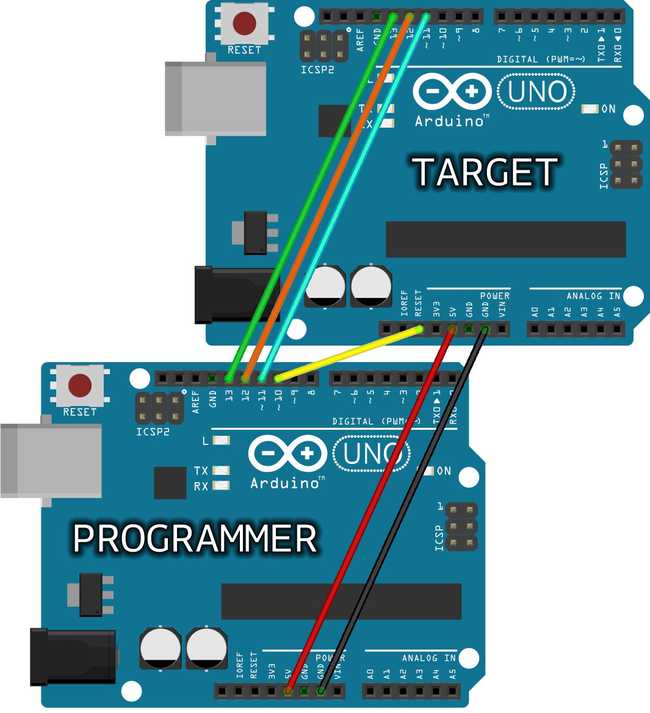
In the picture above nosotros are connecting ii UNO boards for bootloader called-for with the "old style" connections: the top board is the Target, the bottom board is the Programmer. Note the yellow connexion from D10 of the developer to RESET of the target. On MKR family of boards, you can't employ D10 for reset; we propose D6 and you must call up to change the line 73 of the ArduinoISP sketch -
# define RESET ten - putting "6" insteat of x.
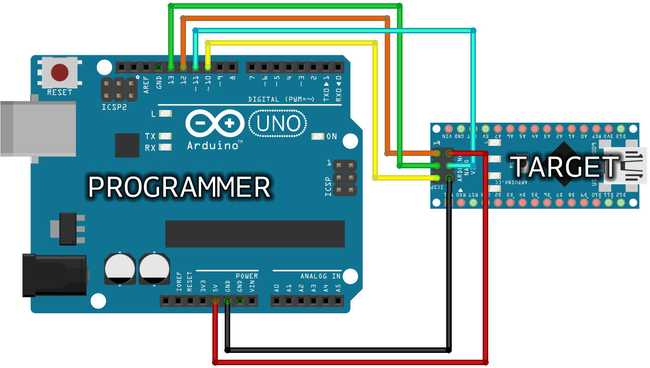
This Arduino NANO is programmed through its ICSP connector with wires coming from D10-D13 of the programmer UNO lath.
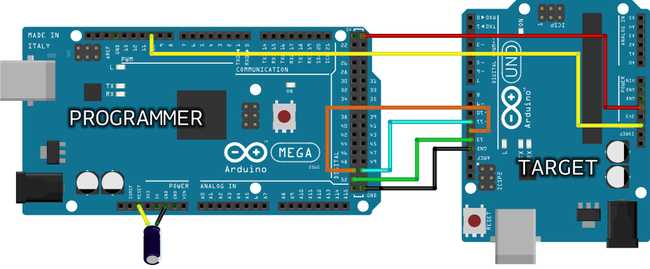
The Arduino MEGA above is programming an Arduino UNO connecting D51-D11, D50-D12, D52-D13, GND-GND, 5V-5V and D10 to RESET. This type of lath needs a x µ F electrolytic capacitor connected to RESET and GND with the positive (long leg) continued to RESET. The capacitor has to be placed afterward the programmer board has been loaded with the ISP sketch.
The x µ F electrolytic capacitor continued to RESET and GND of the programming lath is needed only for the boards that have an interface between the microcontroller and the calculator's USB, like Mega, UNO, Mini, Nano. Boards similar Leonardo, Esplora and Micro, with the USB directly managed by the microcontroller, don't need the capacitor.
About voltages
The Arduino family of boards includes 5V and three.3V devices. When using an Arduino that is not 5V tolerant (Due, Naught, ...) every bit the programmer, make sure to not betrayal any of the programmer'south pins to 5V. A elementary way to attain this is to power the complete system (programmer and target) at 3V3.
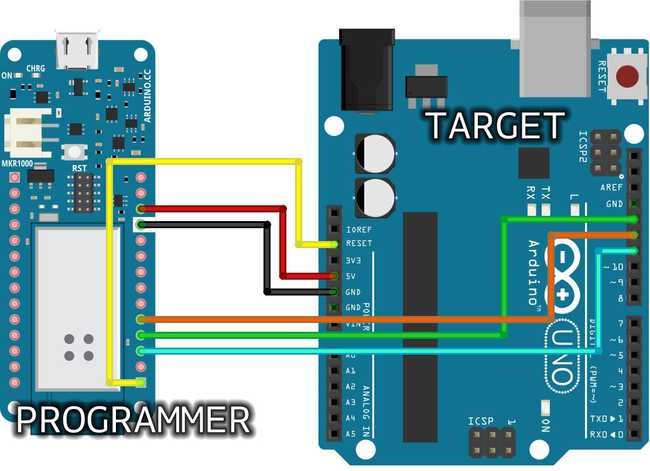
In the above picture you come across the wiring between a MKR1000 and a UNO. Equally described above, everything runs on 3.3V, taken from VCC and GND of the MKR1000 and sent to 5V and GND of the UNO. The same connection could be made to the ICSP of the UNO post-obit the pinout explained in the page. We have used the same colors for the wires as in the other pictures to assistance you switch from the "old wiring" to the ICSP connector with ease. Please notation that the MKR family of boards share the same pinout, therefore you tin can apply whatsoever MKR board equally Internet service provider developer. If you use a MKR lath equally Isp developer, call up to change the line 73 of the ArduinoISP defining the actual pin used on the MKR board to Reset the target (half dozen in the film to a higher place).
Note: Please do not connect to USB or power supply the boards while you lot gear up the connections and wires. Nosotros likewise suggest that y'all first program the Arduino used as Isp programmer before you proceed with the wiring to the target board.
Load the sketch
The Arduino that you will utilize equally programmer needs a specific sketch. Y'all detect information technology nether Examples > xi. ArduinoISP > ArduinoISP .
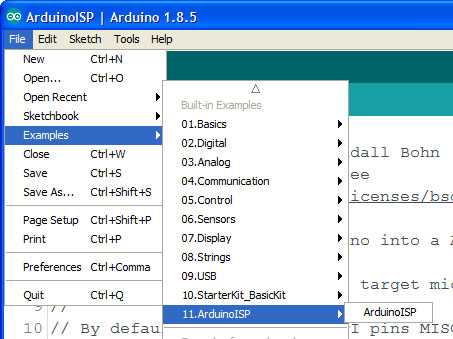
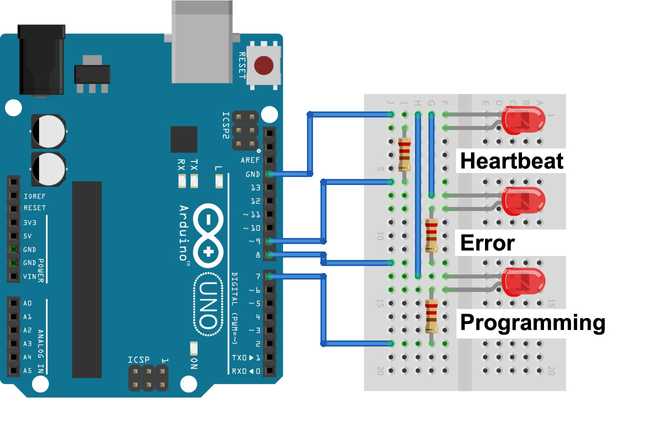
Going through the lines of the sketch you find a number of parameters that need to be set up according to the target board. These parameters are, however, set by a specific file available for each bootloader/lath supported by the Arduino Software (IDE). Other parameters are clearly explained by the comments and should be inverse only if you know what you are doing. The sketch also supports iii LEDs that give you lot a visual feedback about the programming procedure.
To upload the sketch to your Arduino board - the ane that yous volition utilize equally the programmer - you lot need to select board type and port, and then you tin proceed as usual.
Program the bootloader
If all the wires are set, y'all need to switch to the board type you lot want to plan with the bootloader. This step is mandatory to select the proper bootloader code and the fuses configurations. The programming procedure checks the signature of the microcontroller earlier whatsoever writing action is taken, but many boards share the aforementioned microcontroller and each lath has its own bootloader. The port remains the one of the ArduinoISP.
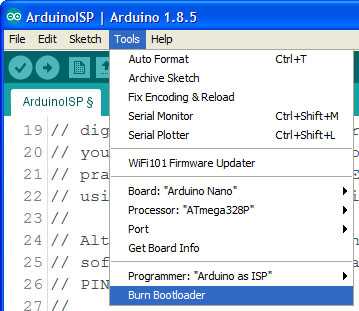
Choose "Burn bootloader" under tools and wait for the confirmation message in the lower part of the Arduino Software (IDE) interface. If y'all connected the LEDs you may follow the procedure visually.
The Serial Programming Mode
The programming process manages the 3 SPI lines (MISO, MOSI and SCK) according to the standard SPI programming protocol, the same used to read and write SD memory cards. The simply deviation with memory cards is the lack of a CS (Flake select) pin. On our AVR microcontrollers we utilise the RESET pin that halts the execution of any sketch or bootloader and puts the microcontroller in a specific state where it listens to the commands arriving from the SPI interface. The very first control that the protocol requires is the one that enters the microcontroller in the Series Programming Mode.
Once this specific mode is active, nosotros tin can write and read all the microcontroller programmable areas: Wink, EEPROM and Fuses. At the end of the Wink memory, we take the bootloader code area, as highlighted in the epitome at the beginning of this article. The "Burn Bootloader" procedure besides sets properly the fuses of the microcontroller according to the design of the board. This is one of the reasons why you lot have to burn the bootloader selecting your exact board model in the list.
Technical aspects of programming
The open source software tool used to plan the microcontroller is avrdude. The process goes through four steps: unlocking the bootloader department of the chip, setting the fuses on the chip, uploading the bootloader code to the chip, locking back the bootloader section of the chip.
The fuses are managed co-ordinate to the preferences stored into each parameter file associated with the board, avoiding potential mistakes.
The direction of fuses, normally a gear up of three bytes - low, high and extended -, is the most delicate aspect of the bootloader programming: a wrong fuse setting could brick the microcontroller and the lath. Fuses define many aspects of the microcontroller's functions like: selecting unlike clock sources and change how fast the scrap runs, setting the minimum voltage required before the chip works (brownout), setting whether or not a bootloader is used, setting how much retention is allocated to the kicking loader (from 256 to 2048 words - 512 to 4096 bytes), disabling reset or serial programming and cease EEPROM data being erased when uploading a new sketch.
Detailed description of the fuses can be found on the datasheet of each microcontroller.
Every setting has its ain usage and it is logical to permit the developer to lock the chip and protect information technology from ISP programming, but it might happen to mistakenly set a fuse in the wrong way, locking you out of the programming process through the ISP interface. To recover the microcontroller, you have to rely on a High Voltage Serial Programmer that uses 12V to reset the fuses.
Epitomize: fire the Bootloader in viii steps
-
Open the ArduinoISP firmware (in Examples) to your Arduino board.
-
Note for Arduino 1.0: you need to make one small alter to the ArduinoISP lawmaking. Find the line in the heartbeat() office that says "delay(xl);" and change it to "filibuster(20);".
-
Select the items in the Tools > Lath and Series Port menus that represent to the lath you lot are using as the programmer (not the board existence programmed).
-
Upload the ArduinoISP sketch.
-
Wire your Arduino boards..
-
Select the detail in the Tools > Board carte that corresponds to the lath on which you want to burn the bootloader (not the lath that you're using equally the programmer). Come across the board descriptions on the environs folio for details.
-
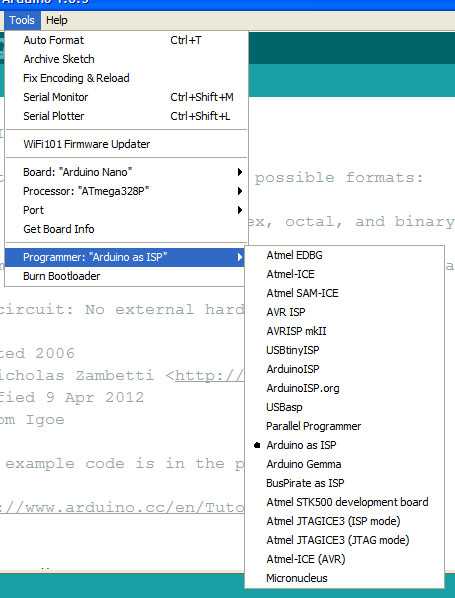
Select the Arduino as ISP in the Tools>Programmer card.
-
Use the Burn down Bootloader command.
Learn more
You tin can find more basic tutorials in the built-in examples section.
You can also explore the linguistic communication reference, a detailed drove of the Arduino programming language.
Final revision: 2018/01/twenty by SM
Source: https://www.arduino.cc/en/Tutorial/ArduinoISP
0 Response to "Arduino as Isp Can Upload but Not With Programmer"
Post a Comment